Welcome to Aijō, the dojo for the Japanese art of rope work
As this page contains content that is not suitable for persons under the age of 18, we ask you to briefly confirm that you are 18 years of age or older and are permitted to view this content. Please click on the “I agree” button below to confirm that you are 18 years of age or older and are permitted to view this content.

The Nine Gates of Osada-Ryū

An intensive partner workshop on the Nine Gates of Osada-Ryū – and therefore on how we tie. Instead of collecting another pattern, we explore position, distance, rope handling, subtle technique, energy, rhythm, intuition, presence and direct transmission in the dojo.

Saturday, 5 and Sunday, 6 December 2026

Nine perspectives on an encounter in rope

The Nine Gates form the theoretical and philosophical core of Osada-Ryū. They complement the technical question “What is tied?” with perception, attitude and interaction. The gates can be named and practised separately, yet they always work together in a session.

Every short theory input is followed by a manageable exercise, reflection within the pair and group feedback. Both roles learn actively: Shibarite makes offers; Ukete perceives, responds and helps shape the shared moment.

All exercises take place on the floor. Consent, physical boundaries and the ability to stop at any time take precedence over every task.

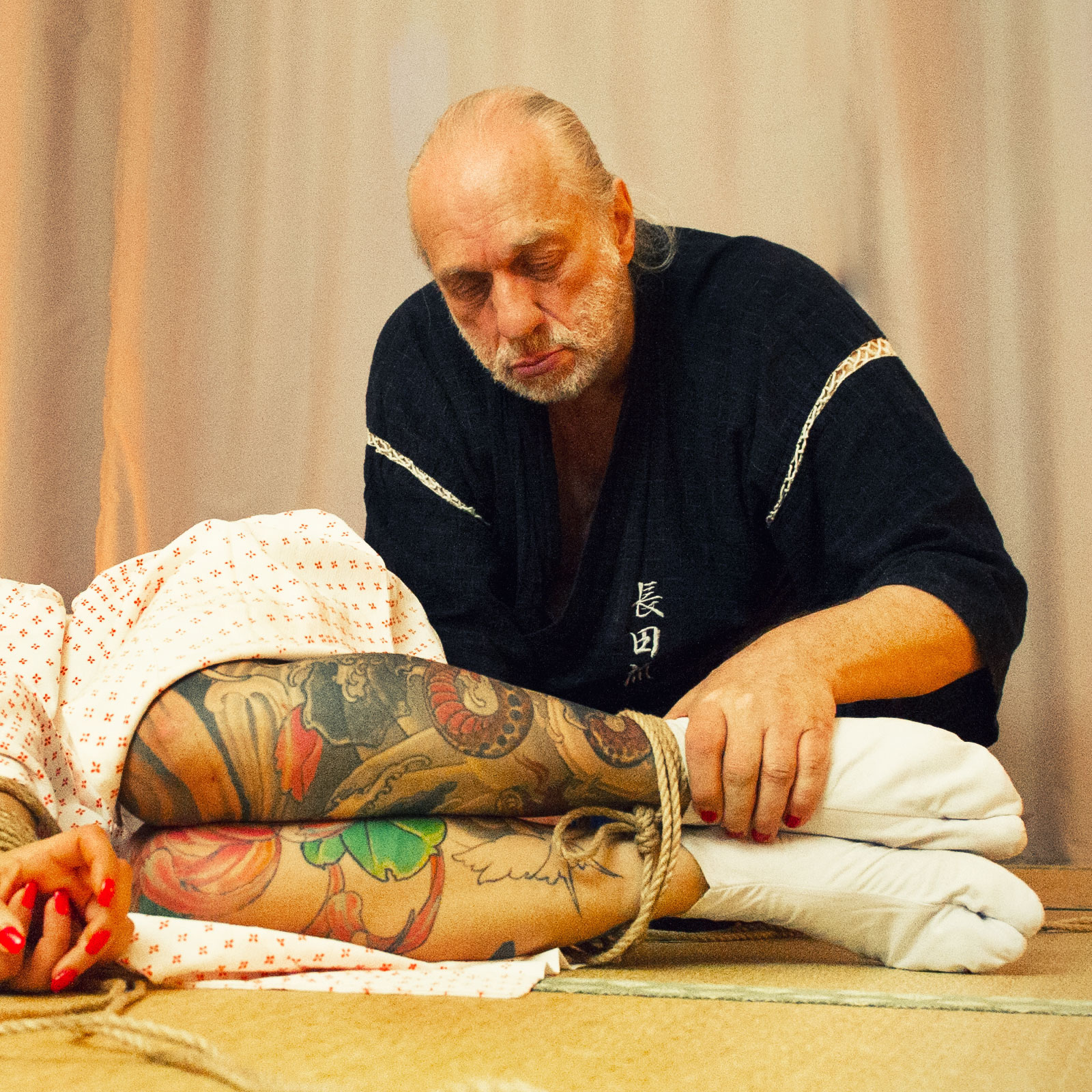
Osada Steve demonstrating Kinbaku and the quality of an encounter in rope

The workshop at a glance

Format
Two-day partner workshop with fixed roles
Prerequisites
A safe one-rope wrist tie and basic rope handling
Date
5 and 6 December 2026
Practice
Comfortable clothing, all exercises on the floor

All Nine Gates and their exercises

Each Gate places the focus on a different quality. During the workshop, all nine aspects are explored in sequence and then brought together in a shared rope session.

Gate 01 · 立位置

Tachi-ichi · Position

Focus: Posture, angle, height and the position of both people in the room.

Exercise: A familiar one-rope wrist tie is started in front of, beside and behind Ukete. After each variation, Ukete describes how presence, eye contact and the power dynamic changed. The pair then consciously chooses a position together.

Gate 02 · 間合い

Ma-ai · Proximity

Focus: The distance at which connection begins, grows or is deliberately withdrawn.

Exercise: The pair explores three distances – beyond reach, rope reach and body proximity. Shibarite approaches slowly while Ukete marks the point where the quality changes. The same short rope path is then repeated at different distances.

Gate 03 · 捌く

Sabaku · Rope handling

Focus: Guiding rope clearly and efficiently, with as little unnecessary friction as possible.

Exercise: Rope is guided in calm paths around the arms and torso without building a new pattern. Hand changes, laying out the rope and consistent tension are practised. Ukete immediately reports friction, changes in pull and restless moments.

Gate 04 · 裏技

Urawaza · Hidden techniques

Focus: Subtle interactions that are barely visible from outside but clearly felt by the pair.

Exercise: The same small movement is accompanied first only through rope, then by a supporting hand, and finally by a shift of weight. Ukete identifies which signals created orientation or closeness. Every variation is agreed beforehand.

Gate 05 · 気

Ki · Energy

Focus: Direction, presence and the perceptible exchange between Shibarite and Ukete.

Exercise: An identical movement is performed with three agreed qualities: calm, decisive and soft. Ukete describes only the received effect; the pair then compares intention and perception without declaring either one the only correct reading.

Gate 06 · 緩急

Kankyū · Tempo and rhythm

Focus: Acceleration, slowing down, pauses and repetition as dramaturgical tools.

Exercise: A short, confidently mastered sequence is repeated in three rhythms. Shibarite then creates an arc of movement and deliberate pauses. Ukete reports when tension, calm or overwhelm appeared.

Gate 07 · 勘

Kan · Intuition

Focus: Perceiving breath, muscle tone, gaze and movement – and checking an assumption.

Exercise: During a simple sequence, Shibarite pauses at three chosen moments, names an observation and asks. The pair then compares which signals were understood and where interpretation was mistaken for fact.

Gate 08 · 無我縄

Muganawa · Empty mind

Focus: Remaining in the present without forcing an image or outcome.

Exercise: After a short arrival practice, the pair begins with one rope and a familiar starting point. The next step arises from the current contact. Whenever thoughts race ahead, the pair pauses, breathes and perceives again.

Gate 09 · 口伝

Kuden · Oral tradition

Focus: Knowledge is transmitted through demonstration, experience, correction and direct exchange.

Exercise: The teacher demonstrates a short application without a script. Pairs reconstruct not only the sequence but also name the experienced quality. In a teach-back, each pair explains one aspect and receives immediate correction.

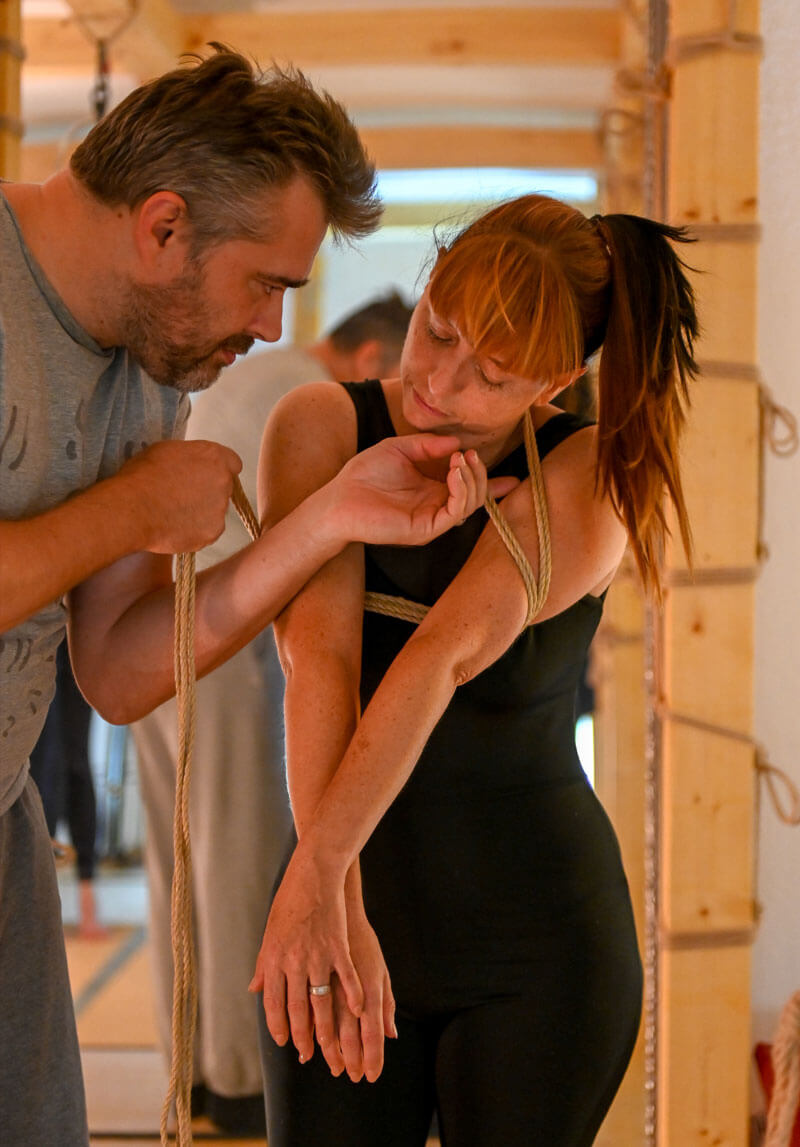
Partner exercise on position, distance and rope handling in the Nine Gates workshop

From a term to a physical experience

Exercises are not evaluated as simply “right” or “wrong”. What matters is whether an intended quality actually reaches the other person. Observation never replaces asking: perception is checked with the partner and is not presented as certainty.

After every block, both people reflect on the experience from their fixed role. This creates a shared vocabulary for effect, intensity and boundaries from both perspectives.

Integration: all gates in a short session

To conclude, each pair creates a short floor session using a familiar pattern. Three gates are chosen consciously beforehand; the others may work in the background. Ukete can ask to change tempo, distance or intensity at any time.

Reflection is not about delivering a performance but about concrete questions: Which intention was perceptible? Where did dialogue emerge? What happened automatically – and what would both like to deepen?

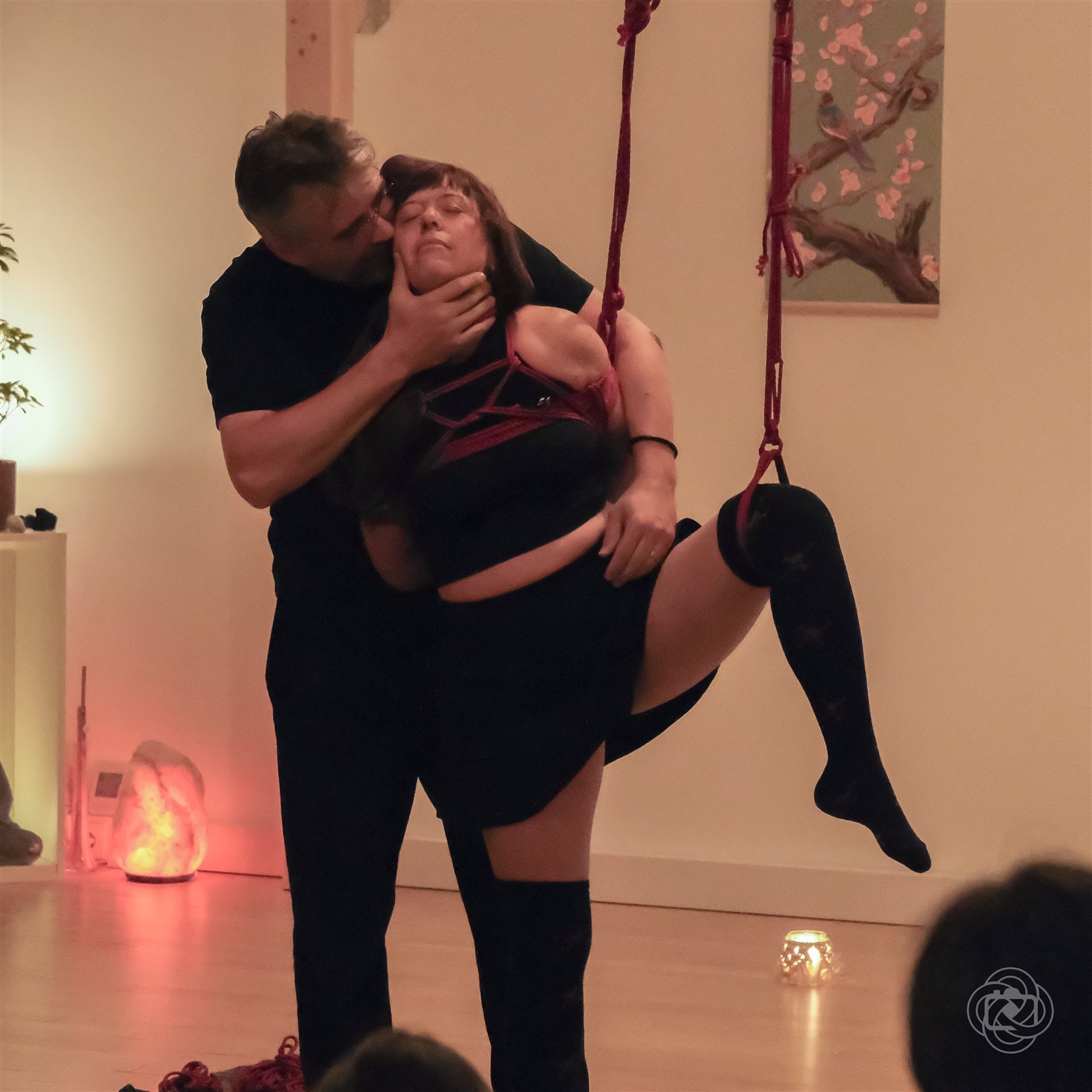
A shared rope-session demonstration featuring elements of the Nine Gates of Osada-Ryū

Who is this workshop for?

For tying partners who want to move beyond reproducing patterns and deepen communication in rope. You should be able to tie a safe one-rope wrist tie, handle rope with control, and be familiar with fundamental safety and consent principles. Suspension experience is not required; there is no suspension in this workshop.

The Nine Gates are not a finished recipe. This workshop opens nine spaces for practice that can be revisited as experience grows.

Context and further information

The terms and their context follow the Osada-Ryū overview by Harukumo-Juku, the presentation by Secret56, and the workshop information from Kinbaku Studio Vienna. The exercises described here are an independent workshop concept by Aijō Dojo.

info@aijo-dojo.ch
Niederlenzerstrasse 29
CH 5600 Lenzburg
+41 (0)76 259 98 35
Copyright © 2026 Aijō.
All Rights Reserved.